1. Introduction: Data-Driven Recovery
Standard athletic rehabilitation often relies on subjective feedback like "feeling better," which can mask underlying muscular deficits through neural compensation. To eliminate clinical guesswork, Dr. Amanda Lewin published her personal AxIT force-sensor baseline data recorded on June 14, 2026. This case study highlights how replacing abstract theory with medical-grade force measurements ensures a safe, objective transition from rehabilitation to peak performance in North Las Vegas athletics.
-
The Clinical Problem: Subjective feedback hides weakness and risks compensation-driven injury.
-
The Solution: AxIT force sensors capture precise, imperceptible data to quantify true joint health.
-
The Goal: Provide radical transparency and an evidence-based framework for elite recovery.
2. The Baseline: Identifying Hidden Vulnerabilities
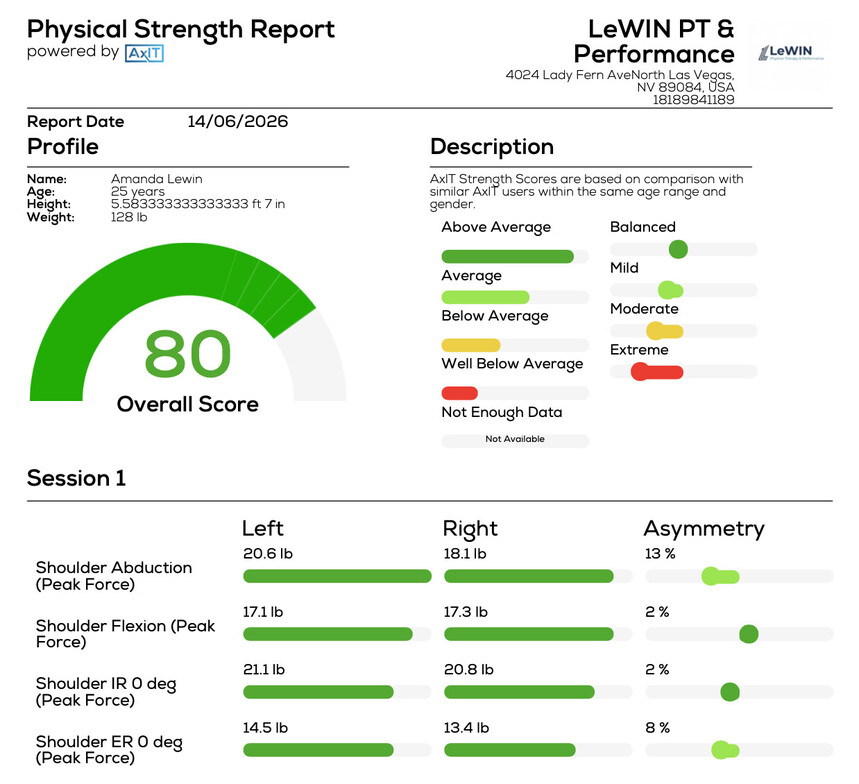
An initial assessment on June 14, 2026, yielded an "Above Average" score of 80, masking latent biomechanical vulnerabilities unsuited for high-load environments. A 13% shoulder abduction deficit created compensatory loading in the external rotators (8% ER asymmetry), dictating a 5-week unilateral force equalization protocol.
| Movement | Left (lb) | Right (lb) | Asymmetry |
| Shoulder Abduction | 20.6 | 18.1 | 13% |
| Shoulder Flexion | 17.1 | 17.3 | 2% |
| Internal Rotation (IR) | 21.1 | 20.8 | 2% |
| External Rotation (ER) | 14.5 | 13.4 | 8% |
3. Five Weeks of Precision: July 19 Results
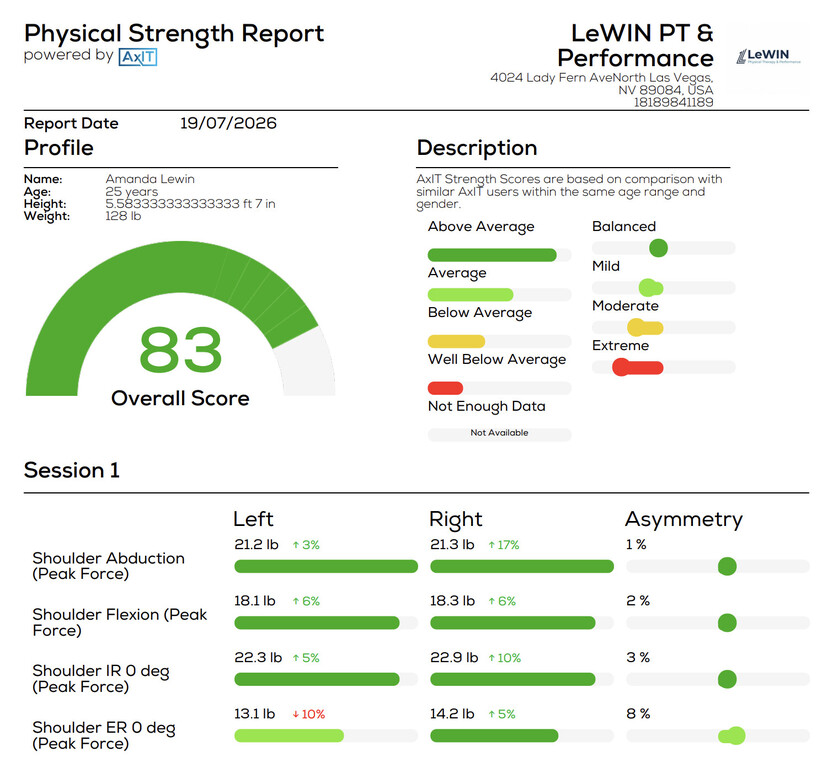
Re-testing on July 19, 2026, raised the Overall Score to 83. The primary breakthrough was completely eliminating the 13% abduction asymmetry down to 0%, optimizing humeral head centering to guard against Subacromial Impingement Syndrome.
| Movement | Left (lb) | Right (lb) | Asymmetry |
| Shoulder Abduction | 21.2 | 21.3 | 0% |
| Shoulder Flexion | 18.1 | 18.3 | 1% |
| Internal Rotation (IR) | 22.3 | 22.9 | 3% |
| External Rotation (ER) | 13.1 | 14.2 | 8% |
-
Abduction Restored: A 17% force increase on the right side erased the primary imbalance.
-
Bilateral Capacity: Flexion improved 6% overall, while IR reached elite output (85th–87th percentiles).
-
Next Phase Focus: ER output stagnated at an 8% deficit, marking it as the primary target for the next training block.
4. The Explosive Edge: RFD and Percentiles
Peak Force measures maximum capacity, but Rate of Force Development (RFD) dictates recruitment speed—critical for explosive athletic movements. High-intent training drove massive neurological adaptations, yielding near-900% RFD gains in shoulder abduction through neural drive rather than muscle hypertrophy alone.
| Shoulder Abduction RFD | Explosive Speed (lb/s) | Percentile |
| Left Side | 112.1 (+882%) | 96th |
| Right Side | 128.8 (+877%) | 99th |
-
Neural Recruitment: Triple-digit gains reflect rapid motor unit firing rather than structural size changes.
-
Elite Explosiveness: Achieving 99th percentile speed on the right side provides the rapid force generation needed for high-velocity performance.
5. Philosophy: Testing vs. Guessing
Traditional physical therapy relies on Manual Muscle Testing (MMT) and subjective "5/5" grades, which cannot detect subtle 8–13% force deficits or distinguish basic recovery from peak athletic performance. Using medical-grade AxIT sensors replaces clinician guesswork with objective, high-precision data.
| Feature | Assembly-Line PT | LeWIN PT (Data-Driven) |
| Assessment | Subjective MMT ("push-tests") | Objective AxIT force sensors |
| Protocol | Generic, standard routines | Precise targeting of isolated deficits |
| Benchmark | "Feeling fine" / pain-free | Documented elite-level output |
-
Deficit Detection: Human hands cannot feel the minor strength gaps where injuries originate.
-
Targeted Recovery: Objective metrics ensure interventions target exact force deficits rather than broad protocols.

Amanda Lewin
Contact Me